
 EN
EN




The design of an outdoor swing represents far more than aesthetic appeal or play functionality. Every structural element, material choice, and engineering decision directly influences how safely children can enjoy the equipment and how reliably the motion remains stable throughout extended use. Parents, playground administrators, and facilities managers increasingly recognize that outdoor swing quality determines whether a play environment truly protects children or introduces unnecessary risk. Understanding how outdoor swing design affects both safety outcomes and motion stability becomes essential for anyone responsible for selecting, installing, or maintaining playground equipment.
Proper outdoor swing design ensures that children experience consistent, predictable motion without jerking, swaying sideways, or sudden instability. The relationship between design principles and real-world safety outcomes cannot be overstated, particularly when outdoor swing equipment operates under constant environmental stress from weather, temperature fluctuations, and daily wear. A well-designed outdoor swing maintains structural integrity while delivering smooth, controlled motion that builds child confidence and encourages healthy play habits.
Core Design Elements That Define Safety in Outdoor Swing Systems
Frame and Support Structure Integrity
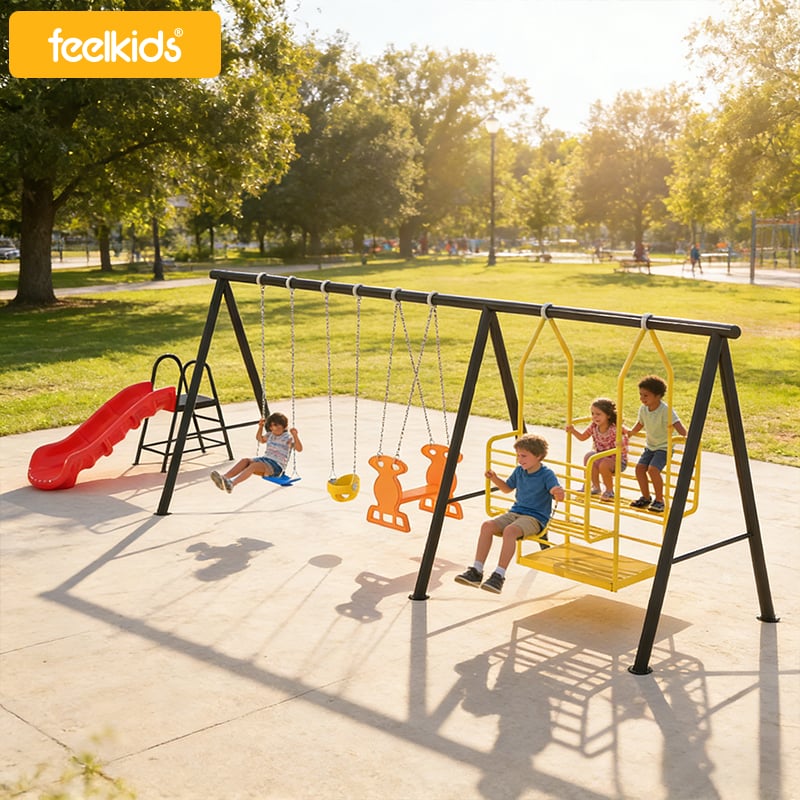
The foundation of any reliable outdoor swing begins with robust frame engineering. An outdoor swing requires a frame constructed from materials engineered to withstand concentrated vertical loads, lateral stress, and ground-level forces generated by multiple children swinging simultaneously. High-quality outdoor swing frames typically use reinforced steel or aerospace-grade aluminum, often with internal cross-bracing that distributes forces evenly across all structural connections. When an outdoor swing frame lacks proper internal triangulation or uses insufficiently thick materials, motion stability deteriorates rapidly, causing visible swaying that compromises safety perception and actual protective performance.
The connection points between frame legs, horizontal beams, and overhead supports represent critical engineering zones within any outdoor swing structure. Each outdoor swing connection must resist both downward pulling forces and horizontal shearing forces generated during vigorous play. Welded joints must meet industrial standards for penetration depth and metallurgical consistency, while bolted connections require proper torque specifications and regular inspection protocols. A properly engineered outdoor swing distributes motion-generated loads away from connection points rather than concentrating stress at vulnerable junctures.
Seat Design and Hanging Hardware Specifications
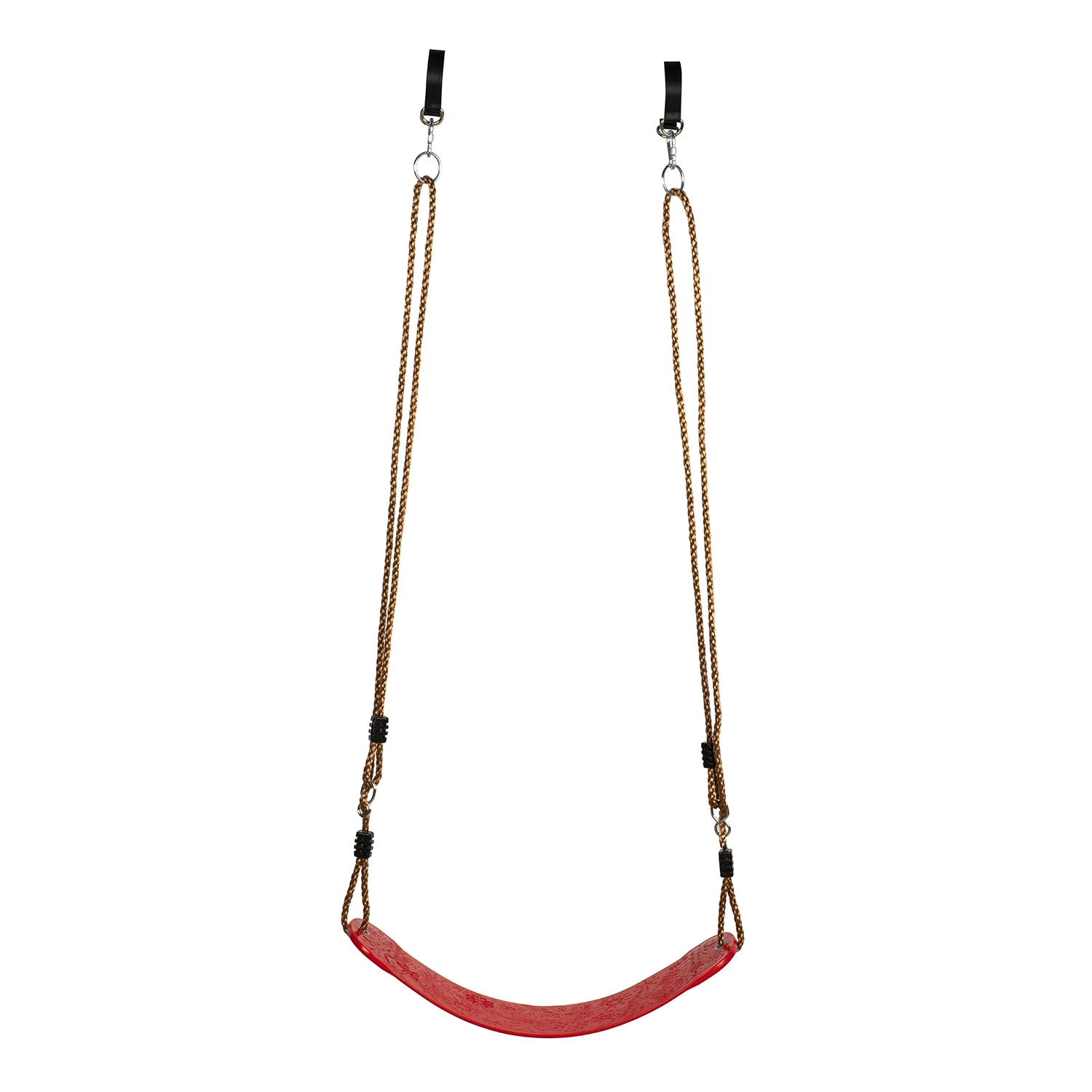
The seat component of an outdoor swing directly influences both comfort and safety outcomes during extended play sessions. Seats designed for outdoor swing applications must accommodate diverse body sizes without creating pressure points or circulation restriction. High-density polyethylene seats or impact-absorbing composite materials distribute body weight more effectively than rigid plastic alternatives, reducing localized stress during impact when children push off from the ground. An outdoor swing seat should maintain ergonomic contours that naturally center a child's weight, preventing tilting that could destabilize the entire swing motion.
Hanging hardware for any outdoor swing must meet or exceed international safety certifications, with load ratings substantially exceeding expected maximum use conditions. The chains, cables, or ropes connecting the outdoor swing seat to the overhead frame should incorporate shock-absorption capabilities that reduce sudden jerking when children pump vigorously or land forcefully. Proper outdoor swing hardware design ensures that motion remains smooth and predictable rather than experiencing abrupt changes in velocity or direction that could cause falls or injury.
Motion Stability Mechanics and Engineering Principles
Pendulum Physics and Harmonic Motion Control
An outdoor swing functions as a controlled pendulum system, where motion stability depends on precise balance between suspension length, weight distribution, and frame rigidity. The physics of an outdoor swing dictates that longer suspension chains produce slower, larger-amplitude motion, while shorter chains create faster, more compact swinging patterns. An effectively designed outdoor swing accounts for these natural pendulum characteristics by positioning the frame low enough to reduce chain length while maintaining adequate clearance beneath the swing seat. When an outdoor swing frame sits too high above ground level, chains become excessively long, causing unpredictable harmonic resonance and lateral wobbling that unsettles children.
Motion stability in an outdoor swing also depends on the frame's resistance to horizontal deflection during asymmetrical loading. When children of different weights swing together on adjacent swings within the same outdoor swing set, unequal forces create dynamic imbalances. A properly engineered outdoor swing frame resists these forces through internal bracing and material density that prevent the overhead beam from bending or twisting. Inadequate outdoor swing design allows the frame to flex excessively, producing visible side-to-side motion that feels unstable and potentially unsafe.
Environmental Factors and Long-Term Motion Stability
An outdoor swing must maintain consistent motion stability across extreme temperature variations, moisture exposure, and seasonal weather changes. Metal components in an outdoor swing expand and contract with temperature fluctuations, potentially creating play in connection points if tolerances were not engineered with environmental stress in mind. High-quality outdoor swing designs incorporate expansion-compatible mounting systems and protective coatings that prevent corrosion-induced structural weakness. When an outdoor swing experiences rust, material degradation, or connection loosening, motion stability deteriorates noticeably as children report jerking, swaying, or creaking during use.
Maintenance accessibility directly correlates with long-term motion stability in any outdoor swing installation. An outdoor swing designed with exposed connection points and simple fastening systems allows regular inspections and preventive tightening before problems develop. Conversely, an outdoor swing with hidden fasteners, welded assemblies, or complex hardware makes identifying and addressing motion stability issues difficult. Facility managers responsible for outdoor swing maintenance benefit tremendously from designs that support routine inspection and component adjustment without requiring specialized equipment or extended downtime.
Safety Standards, Testing Protocols, and Compliance Framework
International Safety Certification Requirements
Responsible outdoor swing manufacturers and facilities managers must understand the safety standards governing playground equipment design, installation, and maintenance. International standards organizations publish comprehensive guidance for outdoor swing engineering, including load-bearing capacity requirements, impact absorption specifications, and motion stability thresholds. An outdoor swing meeting ASTM F1487 standards undergoes rigorous testing for structural integrity, seat design appropriateness, and fall-protection adequacy. These standards ensure that outdoor swing equipment provides consistent safety performance across different manufacturers and installation environments.
Certification for an outdoor swing typically involves laboratory testing of frame materials, connection strength, suspension hardware reliability, and dynamic motion analysis. Each outdoor swing model must demonstrate that maximum expected loads do not cause permanent deformation, dangerous stress concentration, or motion instability. Purchasing decisions for outdoor swing equipment should prioritize models bearing recognized safety certifications rather than assuming all playground swings meet identical protective standards. Documentation of outdoor swing certification provides clear evidence of design compliance and supports liability protection for facilities responsible for child safety.
Field Testing and Performance Validation
Real-world performance of an outdoor swing often differs from laboratory conditions, making field-based safety validation essential for long-term reliability. Facilities installing outdoor swing equipment benefit from documented performance history showing how specific models maintain motion stability and safety performance across multiple seasons and different climate regions. An outdoor swing that passes laboratory certification but fails to maintain motion stability in the field suggests inadequate real-world engineering validation. Performance data from multiple outdoor swing installations in similar climate zones and use intensities provides valuable guidance for facilities considering equipment replacement or expansion.
Ongoing safety monitoring of installed outdoor swing equipment requires systematic inspection protocols that assess frame integrity, connection tightness, motion stability characteristics, and wear patterns. Facilities managers can document outdoor swing performance by recording visual observations, user feedback, and measured motion characteristics at regular intervals. When an outdoor swing begins exhibiting new motion instability patterns or developing visible frame deformation, immediate investigation prevents potential injury and identifies design weaknesses requiring manufacturer feedback or equipment replacement.
FAQ
What specific outdoor swing design features most directly impact child safety?
Frame rigidity, seat ergonomics, suspension hardware quality, and connection point engineering represent the primary outdoor swing design features determining safety outcomes. An outdoor swing with insufficient frame bracing, inadequate seat support, low-quality chains, or poorly designed connections creates multiple safety vulnerabilities. The most protective outdoor swing designs incorporate reinforced steel construction, ergonomic seating, industrial-grade hardware, and welded connections that distribute forces effectively throughout the structure.
How often should outdoor swing equipment be inspected to maintain motion stability?
Regular inspection of outdoor swing installations should occur at minimum monthly during active use seasons, with more frequent checks in high-traffic facilities or regions with extreme weather. An outdoor swing inspection should assess frame alignment, connection tightness, hardware condition, seat integrity, and observed motion characteristics during use. Spring and fall seasonal inspections help identify weather-related degradation before motion stability problems emerge. Facilities experiencing heavy use may require weekly outdoor swing checks to detect developing issues promptly.
Can outdoor swing design modifications improve motion stability in existing installations?
Some outdoor swing motion stability improvements are possible through hardware upgrades, connection reinforcement, or chain length adjustment, though modifications depend on original frame engineering. Adding internal bracing, upgrading suspension hardware to higher-quality materials, or reducing chain length can sometimes restore outdoor swing stability in aging installations. However, fundamental frame design limitations cannot be overcome through modification alone. Facilities experiencing persistent outdoor swing motion instability often require complete equipment replacement rather than attempting incremental improvements to inadequately engineered systems.